
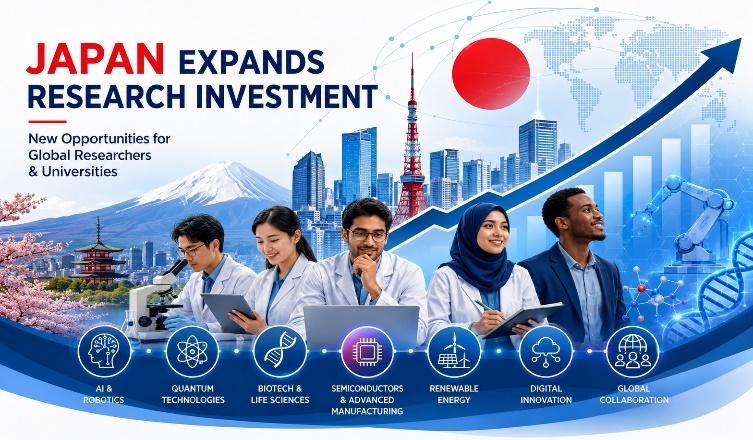
Japan Signals a New Era of Research and Doctoral Investment
Japan is taking significant steps to strengthen its research ecosystem through expanded investment in doctoral education, international collaboration, and advanced scientific research. The initiative reflects the country’s long-term strategy to enhance innovation, improve global research competitiveness, and attract talented researchers from around the world.
The Japanese government has outlined an ambitious goal of expanding its doctoral research capacity, with discussions focusing on increasing the annual number of PhD graduates to approximately 20,000 over the coming years as part of broader national science and technology policies.
Rather than representing a single standalone programme, this objective is supported through multiple initiatives involving the Cabinet Office of Japan, the Ministry of Education, Culture, Sports, Science and Technology (MEXT), national research agencies including the Japan Science and Technology Agency (JST), and The Career & Talent Hub JETRO – Japan Open for Professionals Portal.
Why Is Japan Investing More in Research?
Like many advanced economies, Japan faces several long-term challenges:
- Declining enrolment in doctoral programmes
- Increasing international competition for highly skilled researchers
- Rapid technological transformation driven by artificial intelligence, biotechnology, quantum science, semiconductors, and digital innovation
- The need to strengthen university–industry collaboration and international research partnerships
Japan recognises that sustained investment in research talent is essential for maintaining economic competitiveness and addressing complex global challenges.
What Does This Mean for International Researchers?
Although many funding schemes are administered through individual universities and competitive programmes, the overall policy direction is encouraging for researchers outside Japan.
Potential opportunities include:
• More International Research Positions
Japanese universities are expected to continue expanding recruitment of outstanding international researchers in priority research areas.
• Increased Collaborative Research
Universities worldwide may benefit from expanded opportunities for:
- Joint research projects
- International research consortia
- Visiting scholar programmes
- Co-supervision of doctoral students
- Joint publications
• Stronger Research Infrastructure
Researchers joining Japanese institutions often gain access to:
- Advanced laboratories
- High-performance computing facilities
- Industry-supported research centres
- International interdisciplinary research teams
Opportunities for PhD Students
Prospective doctoral students may find increasing opportunities through:
- Competitive scholarships
- Research assistantships
- University-funded doctoral positions
- International doctoral exchange programmes
- Collaborative doctoral degrees
Many Japanese universities already offer English-medium doctoral programmes, making them accessible to international candidates without requiring advanced Japanese language proficiency at admission.
Who Could Benefit Most?
The policy is particularly relevant for researchers working in strategic fields such as:
- Artificial Intelligence
- Data Science
- Robotics
- Quantum Technologies
- Semiconductor Engineering
- Biotechnology
- Medical Sciences
- Renewable Energy
- Climate Science
- Advanced Manufacturing
- Digital Transformation
- Smart Agriculture
Researchers with strong publication records, international collaboration experience, and interdisciplinary expertise are likely to be well positioned for future opportunities.
Opportunities for Universities Worldwide
The implications extend beyond individual researchers.
Universities across Asia, Europe, Africa, and the Middle East may find new opportunities to strengthen partnerships with Japanese institutions through:
- Memoranda of Understanding (MoUs)
- Joint research centres
- Faculty exchange programmes
- Student mobility initiatives
- Dual doctoral supervision
- Collaborative grant applications
Institutions that already maintain research partnerships with Japanese universities may be particularly well positioned to expand these collaborations.
UFP Insight
Japan’s renewed investment in research is more than a national policy—it reflects a broader global trend. Countries are increasingly competing to attract highly skilled researchers through improved funding, modern research infrastructure, and international collaboration.
For researchers, early-career academics, and universities, this evolving landscape presents opportunities to build stronger international partnerships, access new funding mechanisms, and contribute to globally significant research.
Rather than viewing these developments solely as an expansion of Japanese higher education, they should be understood as part of a wider transformation in how nations invest in research excellence and scientific innovation.
Official Resources
Readers interested in monitoring future opportunities should refer to the following official sources:
- Cabinet Office of Japan – Science, Technology and Innovation: https://www8.cao.go.jp/cstp/english/
- Ministry of Education, Culture, Sports, Science and Technology (MEXT): https://www.mext.go.jp/en/
- Japan Science and Technology Agency (JST): https://www.jst.go.jp/EN/
- Japan Society for the Promotion of Science (JSPS): https://www.jsps.go.jp/english/
- Study in Japan (MEXT): https://www.studyinjapan.go.jp/en/
Below is a more formal, publication-ready version suitable for a UFP News & Insights article. I have also softened a few statements that should not be presented as universal facts unless officially confirmed across all programmes.
Frequently Asked Questions
1. What exactly has Japan announced?
The Japanese government has introduced a comprehensive strategy to strengthen its research and innovation ecosystem by expanding doctoral education, increasing research investment, and attracting high-quality international talent. The long-term objective includes increasing the number of doctoral graduates to approximately 20,000 annually, while enhancing research capacity through reforms led by MEXT, the Cabinet Office of Japan, and national research agencies.
2. Why is Japan implementing this strategy?
Japan is responding to several long-term challenges, including declining doctoral enrolment, increasing global competition for research talent, an ageing workforce, and the growing demand for expertise in emerging technologies such as artificial intelligence, semiconductors, biotechnology, and quantum science. The strategy aims to strengthen Japan’s international research competitiveness and long-term innovation capacity.
3. Who can apply and who will benefit?
Potential beneficiaries include:
- Master’s graduates seeking admission to doctoral programmes.
- PhD candidates pursuing advanced research opportunities.
- Postdoctoral researchers and early-career academics seeking internationally competitive research positions.
- Universities and research institutions through expanded international collaboration, joint research projects, and academic partnerships.
Eligibility and funding arrangements vary according to individual universities and research programmes.
4. Which countries are expected to benefit?
The initiative is open to qualified researchers worldwide. It is expected to create new opportunities for applicants from ASEAN, South Asia, Africa, Europe, North America, and other regions seeking collaboration with Japanese universities and research institutions.
5. Which universities are involved?
Many of Japan’s leading research universities are expected to play a central role in implementing the strategy, including:
- The University of Tokyo
- Kyoto University
- Osaka University
- Tohoku University
- Kyushu University
- University of Tsukuba
- Institute of Science Tokyo
- Okinawa Institute of Science and Technology (OIST)
Additional universities may participate through various national funding programmes.
6. Which research fields are prioritised?
Priority areas include:
- Artificial Intelligence and Data Science
- Semiconductor Engineering
- Quantum Technologies
- Biotechnology and Medical Sciences
- Renewable Energy
- Climate Science
- Robotics and Advanced Manufacturing
- Digital Transformation
These fields are considered strategically important for Japan’s future economic growth and technological leadership.
7. What is the implementation timeline?
The strategy is currently being implemented through successive funding initiatives and institutional reforms. Many programmes are expected to expand progressively over the coming years, with key national objectives extending toward 2030.
8. What should international researchers do next?
Researchers interested in future opportunities should build a strong international publication record.
Great