
Executive Summary
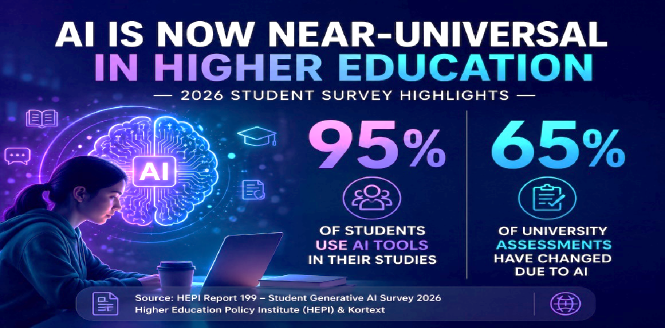
Artificial Intelligence has become an integral part of university learning. According to the 2026 Student Generative AI Survey published by the Higher Education Policy Institute (HEPI), 95% of undergraduate students in the United Kingdom now use generative AI tools to support their studies. However, while AI adoption has become widespread, only 36% of students report receiving adequate institutional support to develop AI literacy and responsible AI skills.
The findings suggest that higher education institutions should move beyond simply regulating AI use and instead focus on developing AI literacy, ethical practices, and responsible academic engagement.
What Has Changed?
The latest HEPI survey indicates that generative AI has rapidly transitioned from an emerging technology to a mainstream learning tool.
Students increasingly use AI for:
- Brainstorming research ideas
- Explaining difficult concepts
- Summarising academic literature
- Improving grammar and writing
- Coding assistance
- Study planning
- Language support
The report also suggests that students expect universities to provide clearer guidance on the appropriate and ethical use of AI in learning and assessment.
AI is no longer viewed solely as a writing assistant but as a learning companion supporting research, study planning, coding, language development, and knowledge discovery
Why Is This Important?
The rapid adoption of AI is transforming higher education worldwide.
Rather than asking whether students should use AI, universities are increasingly focusing on how AI can be integrated responsibly into teaching, learning, and research.
The report highlights a significant challenge: while AI tools are widely available, many institutions have yet to develop comprehensive strategies for AI literacy, assessment design, and academic integrity.
Key Findings
HEPI Student Generative AI Survey 2026
- 95% of undergraduate students reported using generative AI in their studies.
- Only 36% felt adequately supported by their university to develop AI-related skills.
- Students increasingly expect AI guidance to be integrated into their courses.
- Universities are encouraged to shift from an enforcement-focused approach to one centred on responsible AI education.
Who Benefits?
The findings are relevant to:
- University students
- Academic staff
- Curriculum developers
- University leaders
- Educational technology providers
- Research supervisors
- Academic publishers
The report also provides valuable insights for policymakers developing future frameworks for digital education.
What Should Universities Do?
The report suggests several priorities for higher education institutions:
- Integrate AI literacy into curricula.
- Develop transparent policies on ethical AI use.
- Redesign assessments to reflect AI-assisted learning.
- Train academic staff in AI-supported teaching.
- Promote critical thinking alongside technological competence.
- Review assessment strategies regularly as AI technologies continue to evolve.
Developing these skills will help graduates use AI responsibly in both academic and professional settings.
What Does This Mean for Researchers?
Generative AI is increasingly influencing research workflows, including literature discovery, language editing, coding, data analysis, and research planning.
Researchers should ensure that AI tools are used transparently and ethically while maintaining responsibility for the originality, accuracy, and integrity of their work. Many publishers and funding bodies now require authors to disclose significant AI assistance during manuscript preparation.
Researchers should also remain aware of journal-specific AI policies before manuscript submission, as disclosure requirements may differ between publishers.
Global Perspective
The findings reflect a broader international trend. Universities across Australia, Canada, Singapore, the European Union, and the United States are also revising policies to incorporate AI into teaching and research while maintaining academic integrity.
The global conversation is no longer whether AI should be permitted in higher education, but how it can be integrated responsibly while preserving academic integrity and critical thinking.
Frequently Asked Questions
Why are students using AI?
Students primarily use AI to improve learning efficiency, understand complex concepts, assist with writing, generate ideas, and support problem-solving.
Does AI replace learning?
No. AI should complement learning by assisting students, while critical thinking, analysis, and original judgement remain essential human skills.
Should universities ban AI?
Most educational experts now advocate responsible use and AI literacy rather than blanket bans.
Will AI change academic assessment?
Many universities are redesigning assessments to evaluate critical thinking, creativity, and authentic learning alongside responsible AI use.
Can AI be listed as an author?
No.
Most publishers, including leading international journals, do not recognise AI systems as authors because they cannot assume responsibility for the accuracy, originality, or integrity of scholarly work.
UFP Insight
The widespread adoption of generative AI represents one of the most significant changes in higher education in decades. As AI becomes embedded in teaching, research, and scholarly communication, universities and publishers share a responsibility to promote ethical, transparent, and responsible use.
United Frontiers Publisher (UFP) supports the responsible and transparent use of AI in scholarly publishing through clear editorial policies that encourage innovation while safeguarding academic integrity. AI can enhance productivity and discovery, but authors remain fully accountable for the originality, accuracy, and ethical standards of their scholarly work.
Looking Ahead
Artificial intelligence will continue to reshape teaching, learning, assessment, and scholarly publishing. Universities, researchers, publishers, and policymakers must work together to develop responsible AI governance frameworks that encourage innovation while preserving academic integrity, transparency, and public trust.
Official Resources
- Higher Education Policy Institute (HEPI) – Student Generative AI Survey 2026
- HEPI Reports: https://www.hepi.ac.uk/
- Full report: https://www.hepi.ac.uk/wp-content/uploads/2026/03/HEPI-Report-199-Gen-AI-Survey-2026.pdf
- UFP Artificial Intelligence (AI) Policy: https://www.ufpub.com/plagiarism-and-artificial-intelligence-ai-policy/
Source Note: This article presents an independent editorial analysis prepared by United Frontiers Publisher (UFP) based on publicly available information published by the Higher Education Policy Institute (HEPI). Readers are encouraged to consult the official HEPI report for the complete methodology, statistical analysis, and recommendations.