
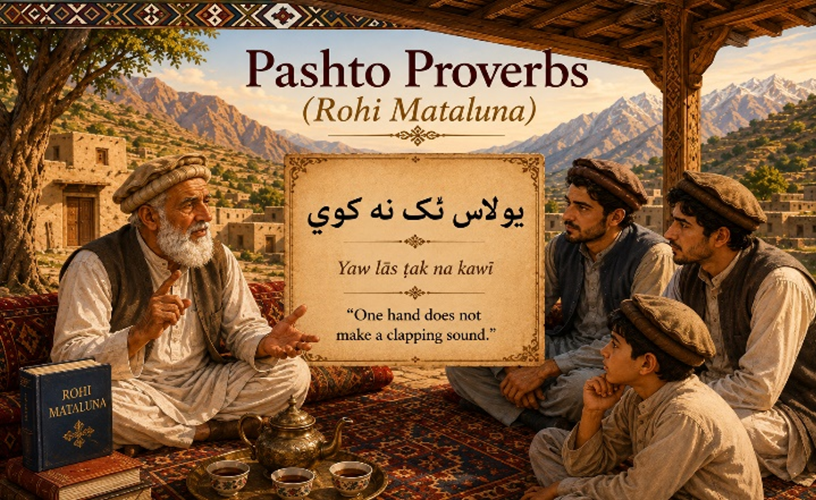
Illustration: AI-generated for this UFP Insight article. © 2026 United Frontiers Publisher.
Published in the Journal of Advances in Humanities Research (JADHUR)
For centuries, Pashto proverbs (Rohi Mataluna) have been passed from one generation to another, preserving cultural wisdom, social values, and practical life lessons. But are they simply expressions of tradition or powerful tools that shape human behaviour?
A recent peer-reviewed study published in JADHUR explores how Pashto proverbs function as persuasive forms of communication. Rather than merely expressing ideas, these traditional sayings help influence decisions, resolve conflicts, reinforce social values, and strengthen cultural identity within Pashtun society.
🔍 Research Insights
✅ 1. Proverbs are persuasive, not merely descriptive.
The study shows that Pashto proverbs are frequently used to encourage action, offer advice, resolve disagreements, and influence behaviour within everyday communication.
✅ 2. Proverbs preserve cultural identity.
Rohi Mataluna reflects the traditions, values, and social expectations embedded in Pashtun society, helping preserve cultural heritage across generations.
✅ 3. Communication without confrontation.
Rather than criticising someone directly, speakers often use proverbs to express opinions diplomatically, making conversations more respectful while still conveying important messages.
✅ 4. Language becomes a social tool.
The research highlights the conative function of proverbs—showing how language actively motivates, persuades, and guides listeners rather than simply transferring information.
✅ 5. Traditional wisdom remains relevant today.
Although rooted in centuries-old traditions, many Pashto proverbs continue to provide guidance on leadership, cooperation, humility, perseverance, and interpersonal relationships.
🌍 Why It Matters
This study demonstrates that traditional proverbs remain valuable linguistic and cultural resources for understanding communication, education, social interaction, and human behaviour. It also highlights the importance of preserving indigenous languages and oral traditions for future generations.
📖 Read the full open-access article:
Ahmad, M., & Bin Mamat, R. (2026). Proverbs in Producing the Intended Discourse: An Understanding of the Conative Functional Aspect of the Pashto Proverbs. Journal of Advances in Humanities Research, 5(1), 39–51. https://doi.org/10.56868/jadhur.v5i1.340.
Open Access: This article is freely available for reading and sharing under the journal’s open-access policy.
💬 Editorial Perspective
While digital communication continues to reshape how people interact, traditional proverb collections such as Rohi Mataluna remind us that effective communication extends beyond exchanging information it also conveys wisdom, builds trust, reinforces cultural values, and strengthens community identity. Continued research on indigenous languages not only preserves cultural heritage but also enriches global scholarship on linguistics, communication, and intercultural understanding.
Editorial Note: This article summarizes findings from a peer-reviewed research publication. Readers are encouraged to consult the full article for complete methodology, limitations, and detailed results.