
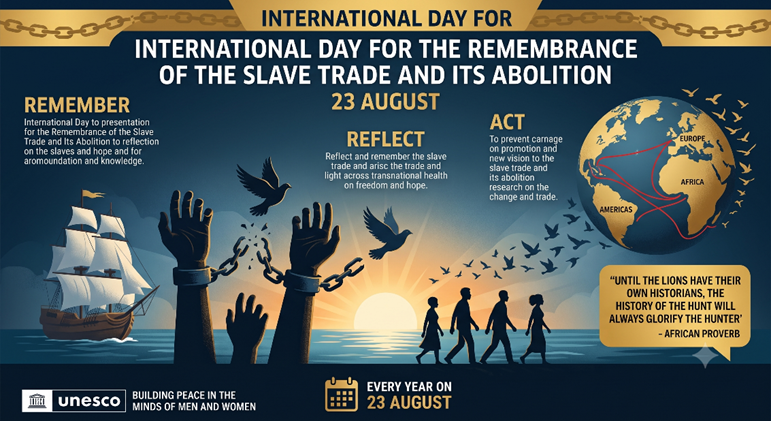
Illustration: AI-generated for this UFP Insight article. © 2026 United Frontiers Publisher.
“Until the lions have their own historians, the history of the hunt will always glorify the hunter.” African Proverb
Every year on 23 August, the international community observes UNESCO’s International Day for the Remembrance of the Slave Trade and its Abolition. The day commemorates the uprising that began in Saint-Domingue (present-day Haiti) in 1791, a pivotal event in the struggle against slavery and the transatlantic slave trade.
More than two centuries later, this history continues to raise an important question for historians, legal scholars, archivists, and humanities researchers:
When historical records were largely created by those in power, how can research recover the voices and experiences that were marginalized, excluded, or left undocumented?
Why This Matters
This international observance honors the memory of millions affected by the slave trade while recognizing the resistance and struggles that contributed to its abolition. Beyond remembrance, it encourages continued education, research, and critical reflection on the historical legacies of slavery and their relevance to human rights, equality, cultural memory, and human dignity today.
Call for Papers | Journal of Advances in Humanities Research (JADHUR)
Legacies of Liberation: History, Memory, Human Rights, and Postcolonial Futures
In recognition of UNESCO’s International Day for the Remembrance of the Slave Trade and its Abolition, the Journal of Advances in Humanities Research (JADHUR) invites original and interdisciplinary research examining historical silences, resistance and liberation, and their continuing significance for human rights, culture, society, and public memory.
Core Research Themes
- Slavery, Resistance & Abolition — Slave trade history, colonialism, resistance movements, abolition, decolonizing archives, and historical memory.
- Human Rights, Reparative Justice & Postcolonial Studies — Reparations, racial inequality, migration, citizenship, diaspora, cultural heritage, and Global South perspectives.
- Digital Humanities, AI & Historical Archives — AI in historical research, digital archives, archival reconstruction, algorithmic bias, cultural memory, and marginalized voices.
JADHUR welcomes original research articles, review papers, theoretical studies, policy analyses, and interdisciplinary scholarship that advances critical and evidence-based understanding of these themes.
Submission Link:
https://www.jadhur.com/index.php/journal/about/submissions
UFP Insight
History is not only about remembering the past it is also about understanding how the past continues to shape the present. Research can recover overlooked voices, examine historical silences, and deepen our understanding of slavery, resistance, human rights, and social justice. Through responsible scholarship and digital innovation, historical knowledge can become more inclusive and accessible. UFP encourages research that connects memory with knowledge, dignity, and a more equitable future.
Official Policy & Academic References
- UNESCO. International Day for the Remembrance of the Slave Trade and its Abolition – 23 August. United Nations Educational, Scientific and Cultural Organization.
- United Nations General Assembly. (2014). Programme of Activities for the Implementation of the International Decade for People of African Descent. United Nations.
- Trouillot, M.-R. (1995). Silencing the Past: Power and the Production of History. Beacon Press.
- Dubois, L. (2004). Avengers of the New World: The Story of the Haitian Revolution. Harvard University Press.
- Noble, S. U. (2018). Algorithms of Oppression: How Search Engines Reinforce Racism. New York University Press.
- Risam, R. (2019). New Digital Worlds: Postcolonial Digital Humanities in Practice. Northwestern University Press.
Publisher’s Note: This content is published by United Frontiers Publisher (UFP) to support academic dialogue, interdisciplinary research, and public awareness of internationally recognized observances. References to United Nations initiatives, UNESCO observances, and Sustainable Development Goals (SDGs) are intended solely for educational, scholarly, and informational purposes and do not imply official endorsement or organizational affiliation.