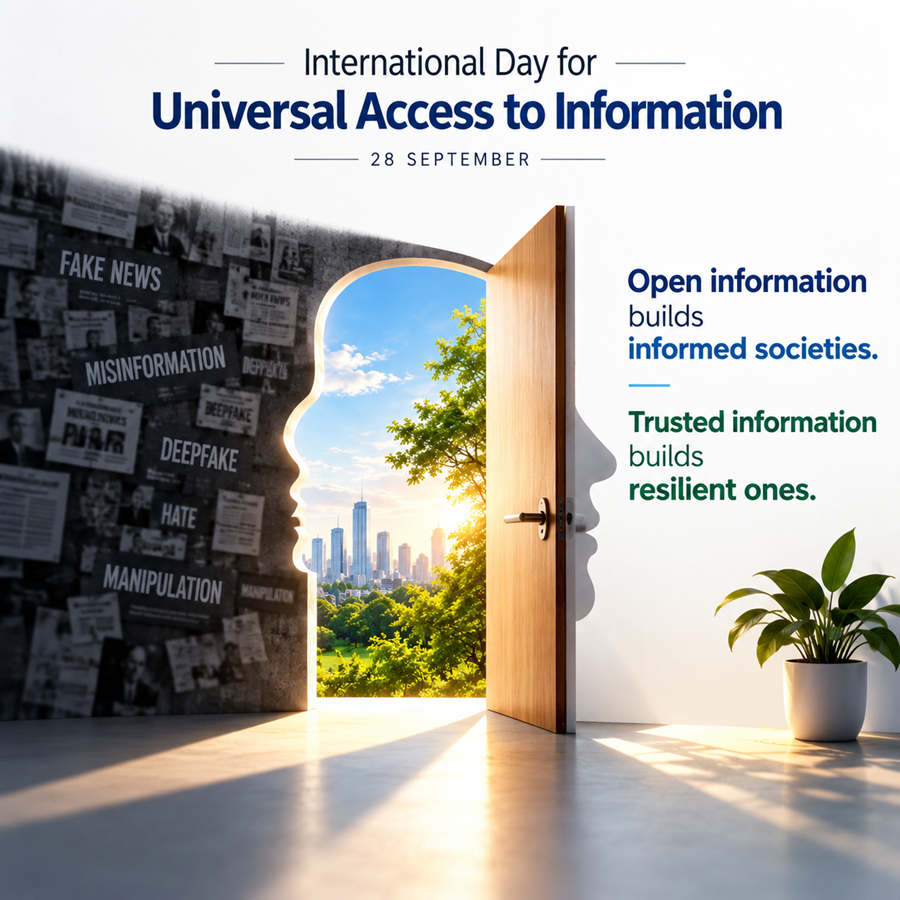
Illustration: AI-generated for this UFP Insight article. © 2026 United Frontiers Publisher.
Every year on 28 September, the world observes the International Day for Universal Access to Information (IDUAI). Proclaimed by UNESCO in 2015 and recognized by the United Nations General Assembly, the day highlights access to information as essential to informed decision-making, inclusion, sustainable development, and democratic societies. For 2026, UNESCO places the spotlight on information integrity in the digital age and the role of access to information in addressing information disorder. In an era increasingly shaped by generative artificial intelligence, algorithms, and automated information systems, access alone is no longer enough.
| Information must not only be accessible – it must also be discoverable, verifiable, preserved, and trustworthy. |
Why This Matters: The 2026 Reality
Digital access has transformed how governments, universities, researchers, and the public create and share knowledge. Yet critical challenges remain: information may technically be open while still being difficult to discover, poorly indexed, inadequately preserved, inaccessible across languages and regions, or overwhelmed by algorithmic noise.
At the same time, governments and societies are confronting misinformation, synthetic media, hate speech, fraud, and other forms of harmful online content. The challenge is not simply to restrict information, but to protect information integrity while preserving freedom of expression, access to information, academic freedom, and legitimate public debate.
UNESCO’s Open Science framework recognizes scientific publications, research data, metadata, repositories, digital infrastructures, and persistent identifiers as important components of an open and reusable knowledge environment. It also emphasizes reducing digital, technological, and knowledge divides within and between countries. Universal access to information is therefore increasingly a question not only of openness, but also of infrastructure, integrity, inclusion, and the capacity to verify what we encounter.
Three Core Research Priorities
1. Open Science, Metadata & Research Provenance
Persistent identifiers such as DOIs, ORCID iDs, and ROR IDs, together with interoperable metadata and reliable digital preservation, can strengthen the traceability and discoverability of scholarly records. Research is needed on how open infrastructure can protect scientific provenance, preserve the scholarly record, and reduce the risks posed by fabricated references, synthetic manuscripts, manipulated data, and unreliable research outputs.
2. AI Governance, Platform Policy & Information Rights
As social platforms and generative AI tools reshape how information is created, filtered, summarized, and consumed, academic inquiry must address algorithmic transparency, public-sector AI accountability, platform governance, social media regulation, information disorder, government data, and citizens’ rights to reliable information.
3. Equitable Open Access & Global Knowledge Inclusivity
Open access does not automatically produce equal visibility. Researchers and journals from underrepresented regions may continue to face barriers involving infrastructure, metadata quality, language, discoverability, preservation, and indexing. Bridging technological and knowledge gaps therefore requires sustained attention to equitable knowledge infrastructure and meaningful Global South participation.
UFP Insight | The Information Paradox: When More Information Does Not Mean More Truth
We are living through an extraordinary information paradox. Humanity has never had such rapid access to knowledge, yet it has also never been so easy to create, manipulate, and distribute convincing false information at scale.
Artificial intelligence intensifies both sides of this transformation. In research and scholarly publishing, AI can accelerate discovery, improve access to literature, support translation, and help researchers analyze complex information. Yet the same technologies can generate fabricated references, synthetic manuscripts, manipulated data, misleading images, and apparently credible scientific claims without reliable provenance. In science, false information can contaminate the scholarly record and, when it influences medicine, engineering, public policy, or other high-stakes decisions, potentially cause real-world harm.
The challenge extends far beyond academia. Across social media and digital platforms, deepfake video and audio, impersonation, manipulated images, fabricated evidence, and rapidly amplified misinformation can distort public understanding, damage reputations, facilitate fraud, intensify social tensions, and, in emergencies or other high-risk situations, potentially endanger lives.
| If anyone can create convincing information, how do we know what deserves our trust? |
The answer cannot be to restrict knowledge indiscriminately. Access to information remains closely connected to freedom of expression and the right to seek, receive, and impart information. The challenge is to protect openness while strengthening verification, provenance, transparency, media and information literacy, responsible AI governance, and accountability.
For the research community, this means strengthening peer review, research integrity, reliable metadata, persistent identifiers, data provenance, preservation, and trustworthy scholarly infrastructure. For society, it means developing the ability to question sources, recognize synthetic and manipulated media, distinguish evidence from fabrication, and avoid sharing potentially harmful information before it can be verified.
The future of universal access to information must therefore be about more than access. It must be about access with integrity.
Information can educate – or manipulate.
AI can democratize knowledge – or industrialize deception.
Open access can accelerate discovery – or accelerate error when verification fails.
Access creates opportunity. Verification creates confidence. Integrity creates trust.Open information builds informed societies. Reliable, verifiable, and trustworthy information builds resilient ones
Official References
International Day for Universal Access to Information
https://www.unesco.org/en/days/universal-access-information
International Day for Universal Access to Information 2026 – Official Theme
https://www.unesco.org/en/articles/international-day-universal-access-information-2026?hub=776
UNESCO Recommendation on Open Science
https://www.unesco.org/en/legal-affairs/recommendation-open-science
UNESCO – Access to Information Laws
https://www.unesco.org/en/access-information-laws
Publisher’s Note
This content is published by United Frontiers Publisher (UFP) to support academic dialogue, interdisciplinary research, and public awareness of internationally recognized observances. References to UNESCO and United Nations initiatives are intended solely for educational, scholarly, and informational purposes and do not imply official endorsement or organizational affiliation.