
Research Equity Requires Shared Responsibility
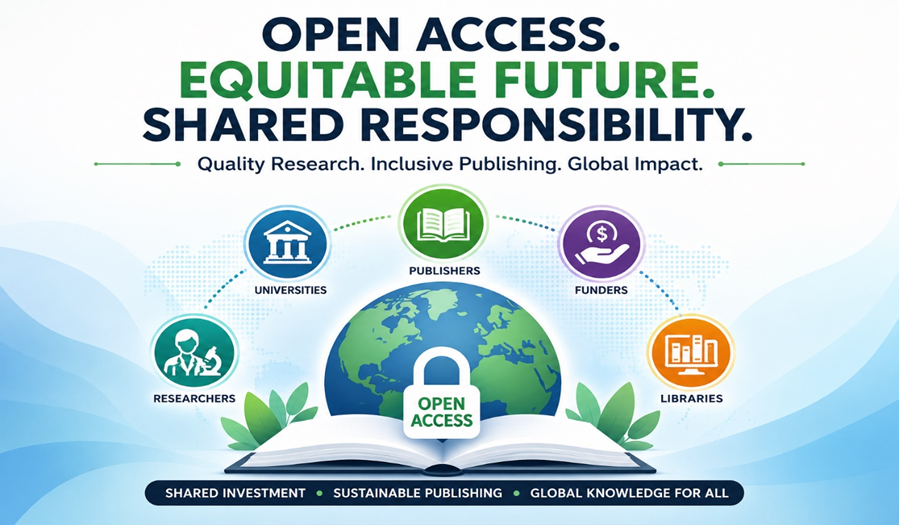
Image Credit: AI-generated illustration developed exclusively for UFP Insight to support the editorial content and policy perspective presented in this article1
Executive Summary
Open Access (OA) has transformed scholarly communication by making research freely available to readers worldwide. By removing subscription barriers, it has expanded access to knowledge, accelerated scientific collaboration, and increased the visibility of research across disciplines. This progress represents one of the most significant achievements in modern academic publishing.
As Open Access continues to evolve, however, the global research community faces an important opportunity: ensuring that the ability to publish is as inclusive as the ability to read.
Many Open Access journals rely on Article Processing Charges (APCs) to support essential publishing services, including editorial management, rigorous peer review, digital preservation, indexing, and long-term accessibility. While this model has enabled the rapid growth of Open Access, publication costs may present challenges for researchers working in underfunded institutions, early-career academics, independent scholars, and disciplines with limited research funding.
The conversation is therefore evolving beyond Open Access alone toward a broader commitment to research equity, shared responsibility, and sustainable scholarly publishing.
1. Research Publications Benefit the Entire Academic Ecosystem
Research publications are far more than individual academic achievements. They strengthen institutional reputation, increase research visibility, support innovation, attract international collaboration, and contribute directly to university competitiveness.
Global university ranking systems—including QS World University Rankings, Times Higher Education (THE), and the Academic Ranking of World Universities (ARWU)—recognize research performance through indicators such as publication output, citation impact, academic reputation, and international collaboration. Universities also use strong research performance to attract talented students, secure competitive funding, and build global partnerships.
Key Takeaway: Because research publications generate long-term value for researchers, universities, publishers, funding agencies, and society alike, supporting scholarly dissemination should be viewed as a shared investment rather than the sole responsibility of any single stakeholder.
2. Aligning Academic Expectations with Institutional Support
Many universities encourage or require publication in internationally recognized, peer-reviewed journals for research assessment, faculty promotion, or postgraduate degree completion. These policies play an important role in strengthening research quality and international visibility. At the same time, institutional expectations are most effective when accompanied by appropriate support mechanisms. Where publication in indexed journals forms part of formal academic requirements, universities are encouraged to consider providing publication support through:
- Institutional research funds and faculty grants;
- Library-led publishing agreements and consortia funding;
- Centralized Open Access support mechanisms for postgraduate researchers.
Supporting research dissemination is not simply a financial consideration, it is an investment in institutional excellence, researcher development, and long-term academic impact.
3. Recognising Quality Beyond Publication Cost
High publication fees do not necessarily indicate higher scientific quality, just as affordable publishing does not imply lower editorial standards.
Universities and research institutions are encouraged to recognize reputable, double-blind peer-reviewed journals that demonstrate strong editorial governance, publication ethics, transparency, and recognized scholarly indexing and established editorial credibility. Community-led, university-based, scholarly society, and independent Open Access publishers all contribute meaningfully to the global research ecosystem by providing high-quality publication opportunities across diverse disciplines.
A balanced publication policy enables researchers to select journals based on academic fit, editorial quality, and research impact rather than publication cost alone.
4. Building a Sustainable Publishing Ecosystem
Around the world, new models are helping to strengthen research equity while maintaining publishing quality:
- Diamond Open Access: Supported by institutional consortia to eliminate fees for both authors and readers.
- Transformative Agreements: Centralizing publishing rights through library-negotiated institutional models.
- Subscribe-to-Open (S2O): Converting traditional library subscriptions into collective funding for universal access.
- Equitable Tiered Pricing: Scaling support mechanisms according to institutional resources.
These approaches demonstrate that sustainable scholarly communication can be achieved through shared responsibility, constructive partnership, and collaborative investment.
5. A Shared Responsibility for Research Excellence
The future of scholarly publishing should not focus solely on who pays publication fees. Instead, it should ask how every stakeholder can contribute to a sustainable and inclusive research ecosystem:
When these responsibilities are shared, scholarly publishing becomes more resilient, more equitable, and better positioned to serve society.
Journal selection should be guided by quality, transparency, ethical publishing practices, and rigorous peer review not by publication fees or indexing status alone.
Policy Recommendations
To strengthen research equity while maintaining academic excellence, higher education institutions and research stakeholders may consider the following policy actions:
- Promote Quality Over Cost: Recognize rigorous, double-blind peer-reviewed journals that uphold strong editorial, ethical, and indexing standards while recognizing that publication cost alone is not an indicator of research quality.
- Align Mandates with Support: Pair indexed publication requirements (for graduation or promotion) with appropriate institutional funding or library mechanisms.
- Expand Institutional Funds: Allocate dedicated internal research support for open-access publishing across diverse faculties.
- Encourage Publisher Diversity: Support a mix of university-based, scholarly society, community-led, and reputable independent Open Access journals.
- Implement Responsible Research Assessment: Value research quality, originality, societal impact, and research integrity alongside traditional bibliometric indicators (in line with DORA principles).
Contribution to the UN Sustainable Development Goals (SDGs)
The principles discussed in this article support the United Nations Sustainable Development Goals by promoting inclusive and equitable access to research dissemination (SDG 4: Quality Education), encouraging sustainable research infrastructure and innovation (SDG 9: Industry, Innovation and Infrastructure), and fostering collaboration among universities, publishers, libraries, funding agencies, and researchers (SDG 17: Partnerships for the Goals). Strengthening research equity ultimately contributes to a more inclusive and globally connected knowledge ecosystem.
Conclusion
Open Access has successfully removed barriers to reading research. The next stage of scholarly publishing is to ensure that opportunities to publish are equally inclusive.
Achieving this goal requires collaboration rather than fragmentation, shared investment rather than isolated responsibility, and policies that encourage excellence while expanding opportunity.
A sustainable scholarly publishing ecosystem is one in which research is evaluated by its quality, integrity, and contribution to knowledge not by the financial capacity of those who produce it. By working together, universities, publishers, funding agencies, libraries, and researchers can strengthen a global research environment that is both excellent and equitable for future generations.
The true measure of Open Access is not simply how many people can read research it is how many researchers have the opportunity to share it.
UFP Insight Policy Perspective
United Frontiers Publisher (UFP) believes that a sustainable scholarly publishing ecosystem is built on quality, integrity, accessibility, and shared responsibility. Advancing research equity requires collaboration among researchers, universities, publishers, libraries, funding agencies, governments, and scholarly societies. Supporting responsible Open Access, rigorous double-blind peer review, and equitable publication opportunities will help ensure that research excellence is determined by scientific merit, ethical standards, and societal impact.
Supporting References
- UNESCO — Recommendation on Open Science (2021)
https://unesdoc.unesco.org/ark:/48223/pf000379949
https://doi.org/10.5281/zenodo.5741832
- UNESCO — Diamond Open Access Initiative
https://www.unesco.org/en/diamond-open-access
- Science Europe & cOAlition S — Action Plan for Diamond Open Access
https://scienceeurope.org/our-resources/action-plan-for-diamond-open-access
https://doi.org/10.5281/zenodo.6282402
- DORA — San Francisco Declaration on Research Assessment
- COPE — Core Practices (Committee on Publication Ethics)
https://publicationethics.org/core-practices
- DOAJ — Principles of Transparency and Best Practice in Scholarly Publishing
https://doaj.org/apply/transparency
UFP Insight Note: This article presents an independent policy perspective intended to encourage constructive dialogue on scholarly communication and research equity. It does not endorse or criticize any specific university, publisher, journal, ranking organization, or funding agency. The views expressed aim to support evidence-informed discussion on strengthening sustainable and inclusive research ecosystems.